


Thoughts for Remembrance Sunday
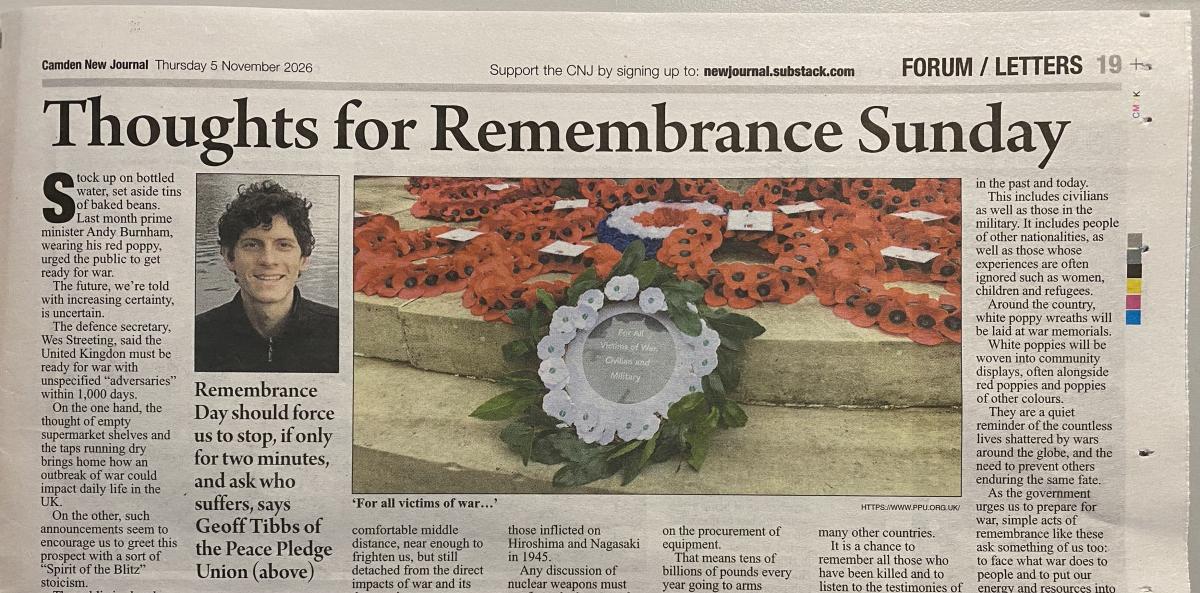
Thoughts for Remembrance Sunday
Geoff Tibbs, PPU Remembrance Project Manager, shares this opinion piece, first published in the Camden New Journal on 5th November 2026.
Stock up on bottled water. Set aside tins of baked beans. Last month Andy Burnham, wearing his red poppy, urged the public to get ready for war. The future, we’re told with increasing certainty, is uncertain. The defence secretary, Wes Streeting, said the UK must be ready for war with unspecified ‘adversaries’ within 1000 days.
On the one hand, the thought of empty supermarket shelves and the taps running dry brings home how an outbreak of war could impact daily life in the UK. On the other, such announcements seem to encourage us to greet this prospect with a sort of 'Spirit of the Blitz' stoicism.
The public is already being asked to accept a massive increase in military spending to 3.5% of GDP by 2035, as chancellor John Healey confirmed in his October budget, at the expense of everything from overseas aid to heat pumps. Now we’re being asked to participate in this growing militarisation and accept that everyday sacrifices will come with it.
With Remembrance Day approaching, we should pause to consider what that means. War is easier to contemplate when it’s presented as an abstract contest between good and evil, and when its victims are out of sight. Talk of readiness, spending targets and military capability keeps the discussion in a comfortable middle distance, near enough to frighten us, but still detached from the direct impacts of war and its devastating weaponry.
Seldom are we invited to consider what a major military confrontation between nuclear armed powers would really look like. The UK is currently replacing its nuclear submarines and purchasing jets capable of firing ‘tactical’ nuclear warheads. Just one of these weapons could unleash a blast vastly greater than those inflicted on Hiroshima and Nagasaki in 1945. Any discussion of nuclear weapons must confront the horrors of the past, which offer a harrowing window into the devastation they could cause today.
And what about conventional arms? Behind every discussion of new tech and industrial growth lurks a question: what are these weapons designed to do? Who will suffer the consequences? The UK spends about a third of its military budget on the procurement of equipment. That means tens of billions of pounds every year going to arms companies such as BAE Systems, whose weapons have recently rained such destruction on Gaza and Yemen.
Remembrance Day should force us to stop, if only for two minutes, and ask who suffers. It is an opportunity to reflect on the devastation war has caused throughout the twentieth century, and is continuing to cause today in Ukraine, Palestine, Sudan, and many other countries. It is a chance to remember all those who have been killed and to listen to the testimonies of those still living with the consequences. Their great suffering should be the starting point of any debate about security, and should remind us of the urgent need for nonviolent solutions to conflict.
This is the understanding of remembrance expressed by the white poppy. Worn since 1933, it stands for remembrance of all victims of war, both in the past and today. This includes civilians as well as those in the military. It includes people of other nationalities, as well as those whose experiences are often ignored such as women, children and refugees.
Around the country, white poppy wreaths will be laid at war memorials. White poppies will be woven into community displays, often alongside red poppies and poppies of other colours. They are a quiet reminder of the countless lives shattered by wars around the globe, and the need to prevent others enduring the same fate.
As the government urges us to prepare for war, simple acts of remembrance like these ask something of us too: to face what war does to people, and to put our energy and resources into preparing for peace.
The National Alternative Remembrance Ceremony, the largest annual white poppy event, will take place in Tavistock Square, London, at 12 noon on Remembrance Sunday, 8th November. Other white poppy events will be taking place across the country.