


White poppies widely embraced across the UK
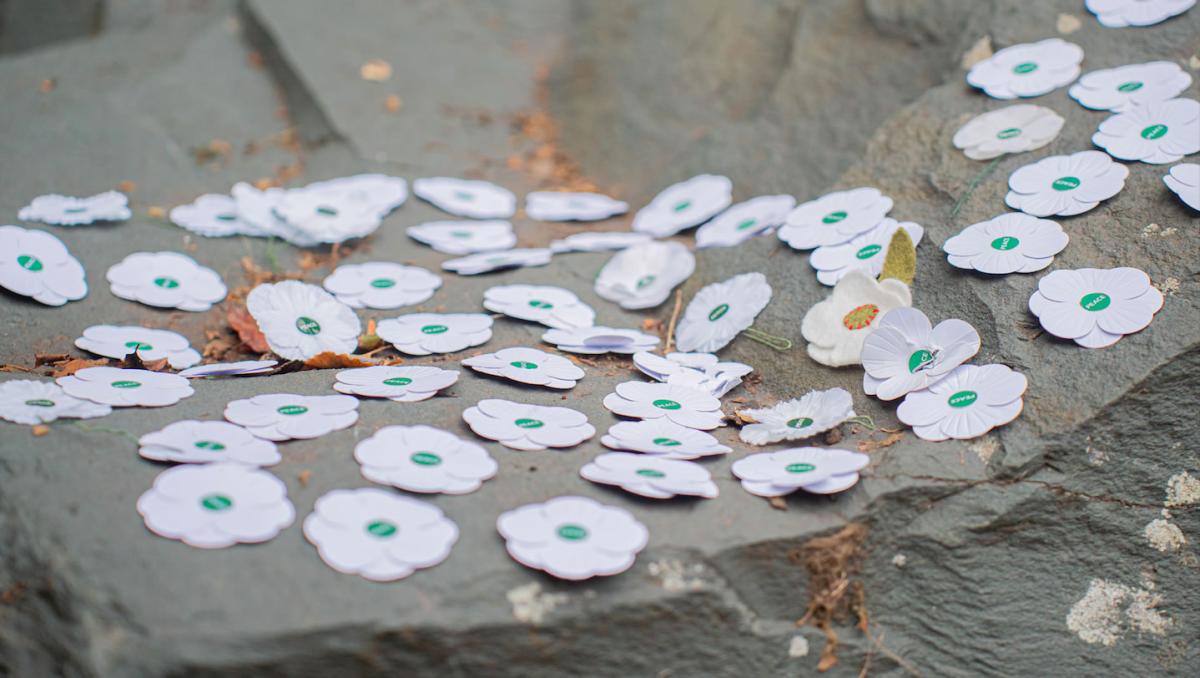
White poppies widely embraced across the UK
It's become a familiar pattern. Every year, in the weeks before Remembrance Day, certain public figures and parts of the media attempt to ramp up the 'poppy wars'. The 'official' approach to remembrance, centering on the red poppy and The Cenotaph, so it's claimed, is the only true remembrance. Anyone wearing a white poppy or offering any differing perspective is accused of being unpatriotic, disrespectful or worse.
This year the argument has felt especially reheated. Some news stories simply rehashed controversies from previous years. Others inflated trivial issues, such as the non-existent 'poppy ban' in Wetherspoons pubs. On the Jeremy Vine show, a panel was asked if they objected to people wearing white poppies and poppies other colours - and virtually nobody did.
Which is, in fact, the most common reaction. The vast majority of people, as revealed in this new YouGov poll, have no problem with people wearing white poppies. This is the view now accepted (if reluctantly) by the BBC and even reflected in the government's recent briefing on Remembrance Day, which mentions the white poppy's longstanding place in the UK's remembrance traditions.
The truth is, when it comes to Remembrance Day, there is far more coexistence and cooperation than conflict.
Over the past few years we have seen a proliferation of remembrance ceremonies and memorials featuring white poppies alongside other kinds of poppy. You often wouldn't guess from the national media coverage, but white poppies have become a widespread and longstanding presence in communities across the UK.
This year, white poppies have been spotted in local memorial installations in Chickerell, Coventry, Crewkerne, Friston, Medbourne, Moreton, Wareham, Wombourne and other places.
In Bewdley in Worcestershire, a cascade of poppies pouring from the roof of a church turned from red to white and purple, and back again. In the village of Lydford in Dartmoor, a field of red poppies changed gradually into a field of white. At Lichfield Cathedral, more than 100,000 handmade poppies - including many white - are being knitted in preparation for Remembrance Day 2027.
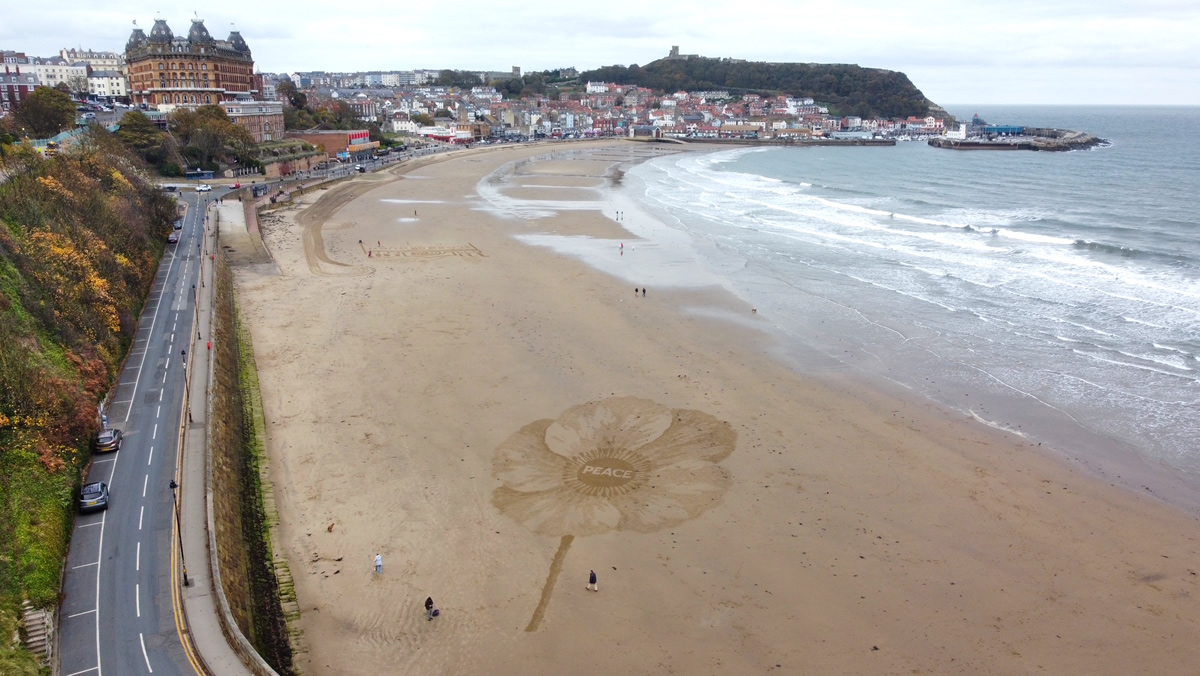
A giant white poppy was inscribed in the sand in South Cliff, Scarborough by the beach artist Fred Brown. As the tide came in on Remembrance Sunday, the artwork was washed away.
Meanwhile in a growing number of cities, towns and villages, white poppies are now an established part of official remembrance ceremonies. This is a result of the perseverance of peace campaigners working successfully with local councils, the Royal British Legion and others to ensure that white poppies have a presence.
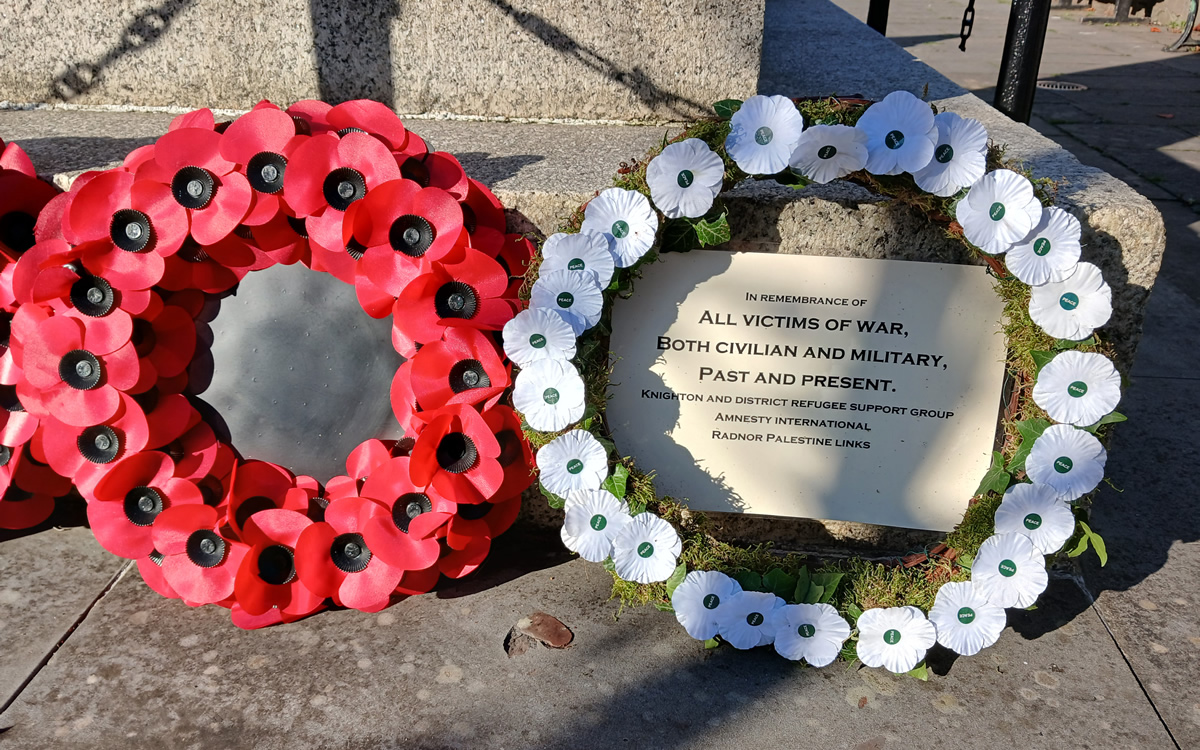
White poppy wreath laid by local peace groups, alongside a red wreath, at the Remembrance Day ceremony in Knighton, in coordination with the local council and the Royal British Legion
In Leicester, white poppy wreaths were laid at the official city ceremony on Remembrance Sunday, as they have been for several years. In a number of places including Macclesfield, Haverhill, Haringey and Gilfach Goch, white poppy wreaths were laid by local councillors and other public officials. In Aberystwyth, both white and red wreaths have been laid for over ten years.
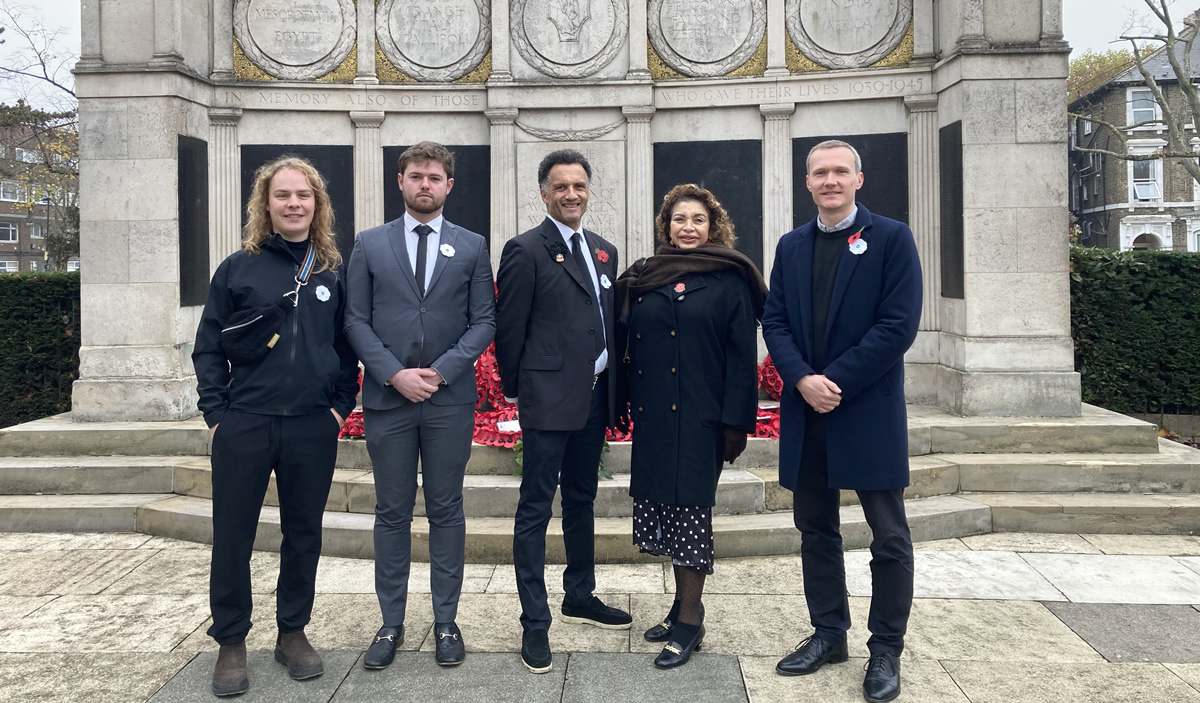
The Leader of Haringey Council Mark Blake with several other councillors wearing white poppies, at Haringey's civic ceremony at Wood Green
Many more ceremonies took place separately from official commemorations, focussing on the white poppy's message of peace, opposing militarism and remembrance for all victims of war. Local peace groups organised events in Bath, Bridgwater, Brighton, Bromley, Bury St Edmunds, Edinburgh, Leamington Spa, Norwich, Nottingham, Uppermill, Uxbridge, Wokingham and other places.
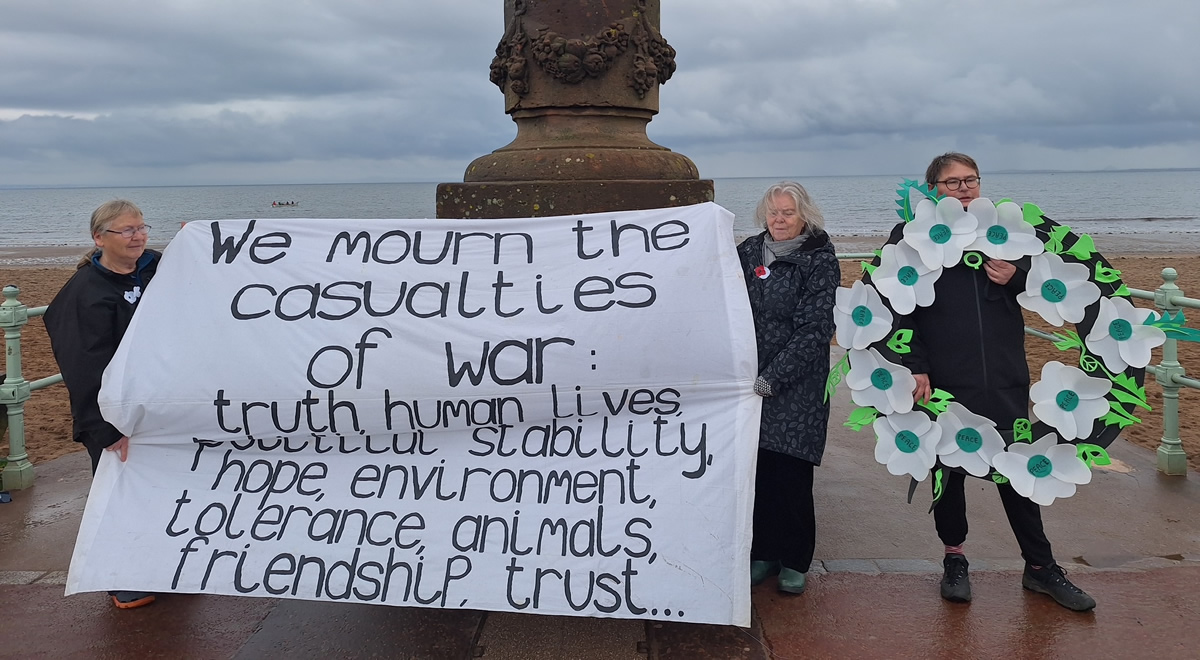
Vigil organised by the Gareloch Horties, a women's peace group, in Edinburgh
In London, the National Alternative Remembrance Ceremony, organised by the Peace Pledge Union (PPU), took place in Tavistock Square in front of the memorial stone for conscientious objectors. It was attended by around two hundred people, who held two minutes' silence in memory of all victims of war, both past and present.
Nelufar Hedayat, an Emmy Award-winning journalist, producer, director and presenter, spoke about her childhood experiences fleeing war in Afghanistan. "For millions of children born into the world today, whose futures are stolen from them, from the first breath they take - I speak for us next. For me, the opposite of war isn't just peace - it is connection."
Around the square, an exhibit on the lives of people recently killed in war was installed by Every Casualty Counts (ECC). Tom Donnelly, ECC's Executive Director, spoke to the gathering about the charity's vital work supporting casualty recording in war zones around the world.
The gathering also heard from the writer and sculptor Phineas Harper, who spoke about the deep impacts of the Second World War, including on their grandfather who was conscripted as a teenager: "It's partly because of him that I wear a white poppy, acknowledging that the majority of those killed by wars are civilians, like those he buried at the Bergen-Belsen concentration camp that his regiment was sent to liberate."
The event was hosted by comedian and PPU member Kate Smurthwaite, who explained how remembering the victims of war underpins our ongoing struggle for peace.
Following the widespread support for white poppies across the UK this year, the PPU is encouraging people to plan ahead for 2027 and to seek out local opportunities to include white poppies in remembrance events, whether in coordination with local councils or independently.
Would you like advice on how to hold a remembrance event or approach councils about including white poppies? Please get in touch at mail@ppu.org.uk
Top image - Philip Wood - National Alternative Remembrance Ceremony, London, 2026