Annual Report 2025
Introduction
At the start of 2025, the world felt dangerously unstable. Wars in Gaza, Ukraine, Sudan and many other places continued to inflict immense suffering. In the face of powerful states and interests, international institutions and norms seemed powerless to halt the cycle of violence. Sadly none of this has changed.
Then, in January 2025, Donald Trump returned to office. The UK, along with the rest of Europe and much of the world, has responded to the changing world order with ever-increasing militarism. The growth of military spending, the development of advanced weapons technologies and the assumption that security can only be achieved through military strength are not new trends, but they have intensified. Heightened militarism has become the new normal.
At this moment, the PPU's message seems more and more urgent. The Peace Pledge commits us to opposing war, as well as the causes of war - and we are surrounded by the causes of war. A growing arms race between major powers, AI-driven weaponry, racism, and division in our communities.
It is essential that we articulate a different vision: a world governed not by endless militarism, but by the needs of human beings - dignity, peace, a habitable planet and genuine security.
More than at any time in recent years, we must be ready to make that case clearly and consistently. In the face of a militarised political consensus, we have to show, through our words and actions, that a different future is possible.
This has been our focus throughout 2025, guided by our 2024-27 strategy. The report below outlines how PPU members and supporters have challenged the status quo and stood up for peace - whether by challenging public displays of militarism, such as Armed Forces Day, providing a platform for conscientious objectors, or empowering young people to talk about war and peace.
The report covers our four campaigning areas - Everyday Militarism, Remembrance and White Poppies, Peacebuilding and Nonviolence and Military Spending and Recruitment - as well as a summary financial report.
After operating with a reduced staff team for several years, we are looking forward to welcoming a new Communications Manager in June, thanks to the generous support of the Peace Research and Education Trust. In 2025, our staff consisted of our Operations Manager, Amy Corcoran, our Remembrance Project Manager, Geoff Tibbs, and Laura Fensterheim, our Remembrance Project Intern, who joined us in the run up to Remembrance Day.
Everyday Militarism
Against a backdrop of growing militarism, everyday instances of military images, ideas and influence - what we call everyday militarism - become crucial for generating public consent. But where there is militarism, there will be resistance. We oppose everyday militarism wherever we find it - in communities, schools, universities and public debate.
The PPU has challenged Armed Forces Day since it was introduced in 2009. Not only do these events glorify and normalise the military, but they are often marketed as 'family fun', with children routinely given real weapons to handle. In 2025, we supported a record number of demonstrations and other actions to challenge Armed Forces Day in towns and cities across the UK - triple the number compared with 2024, with demonstrations, vigils, stalls and flyering in over fifty locations.
This steep increase in protest reflects public outrage at the UK’s support for Israel actions in Gaza and Iran, as well as opposition to the deepening militarism in the UK in the wake of the government’s Strategic Defence Review, National Security Strategy and huge increases in military spending.
As in 2024, we collaborated with ForcesWatch in 2025 to distribute materials to support these protests. Postcards and stickers saying 'War is Not Family Entertainment' were sent to groups and individuals in Aldershot, Birmingham, Eastbourne, Exeter, Glasgow, Guildford, Ipswich, Lancaster, Leicester, Liverpool, Plymouth, Reading, Wolverhampton and many other places.
In York, the protests made a tangible impact on plans for Armed Forces Day in the city. Local residents, including PPU members and supporters, held peace stalls and vigils, organised a letter writing campaign and contacted decision makers - with the result that City of York Council decided that military vehicles and weapons would not be included in the Armed Forces Day parade.
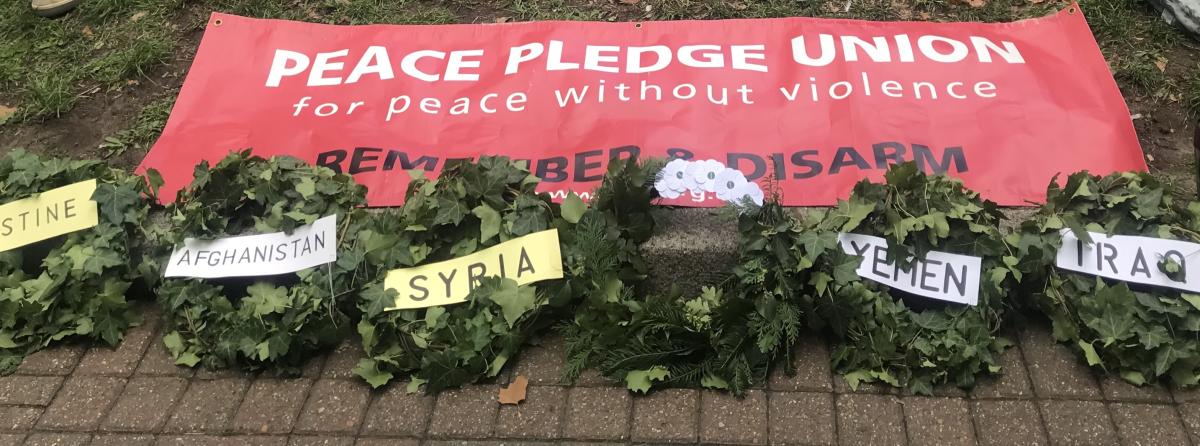
Arms fairs are not only occasions to sell lethal weapons to authoritarian regimes, they are also a form of everyday militarism, with profound effects on local communities. In September 2025, the euphemistically titled Defence and Security Equipment International (DSEI) arms fair, one of the world’s largest weapons fairs, took place in London. We worked with Every Casualty Counts (ECC) - an organisation devoted to remembering and recording every life lost in war - to take action. As arms dealers entered DSEI, they were greeted with a remembrance ceremony for all the victims of their deadly trade.
We read stories of people who lost their lives to armed conflict in 2024, focusing on individuals from Palestine, Afghanistan, Syria, Ukraine, Iraq and Yemen, and highlighting the involvement of the UK government in these conflict zones. We held moments of silence and sounded a bell every 12 minutes to mark another civilian killed in war (as per ECC’s findings).
DSEI is morally indefensible, and it was encouraging to see so much action against the arms fair in 2025. There are many people willing to stand up for a more peaceful and just world, and in a moment where the challenges can feel insurmountable, this gives us hope and strength. We are particularly grateful to PPU members and supporters who travelled to the Excel Centre in the midst of a tube strike to bear witness and participate in our joint vigil. It was a challenging environment, with more forceful policing than in previous years, but it was important we were there, making our voices heard.
Remembrance and White Poppies
As we all know, civilians make up the large majority of casualties in most conflicts today. As we pointed out on the 80th anniversary of VE Day in May last year, this was even true during the Second World War.
In 2025, new research showed that global civilian war deaths had reached record levels, a fact bourne out by the constant stream of atrocities in the news. The absence of civilians from mainstream remembrance events was all the more glaring.
With Remembrance Day approaching, we renewed our efforts to ensure that civilians receive proper recognition, in collaboration with Every Casualty Counts (ECC). In a joint press release, we explained: "The number of civilian deaths worldwide jumped by 40% in 2024... The death toll is especially acute among children."
On Remembrance Sunday, we saw a burst of energy among our supporters, who organised record numbers of white poppy ceremonies, stalls and other events around the UK. The number of such events has doubled in recent years - reaching forty-five in 2025 - with more official commemorations now including white poppies, in addition to many independent ceremonies.
We released a new webpage on ‘How to organise a white poppy ceremony’, to help build on this momentum.
In another positive sign, senior figures in the Green Party stepped up their support for the white poppy. After attending the Cenotaph, Green Party leader Zack Polanski joined us for the National Alternative Remembrance Ceremony, saying, "Remembrance should not only be about the past but also look towards a better future. It should be about actively promoting peace and to say wholeheartedly: never again." Meanwhile, Green MP Carla Denyer laid a wreath of white and red poppies at Bristol’s official ceremony.
Every year, the white poppy reaches tens of thousands of people across the UK and the world. This is only possible due to the hard work of PPU members and supporters, who take them into shops, schools and community spaces, hand them out on street corners, and pack them in the PPU office. Through our work with Woodcraft Folk and Cymdeithas y Cymod, we are reaching more young people and outlets in Wales. We are enormously grateful to all the individuals and allied organisations who worked on the campaign. In total, 71,000 white poppies were distributed in 2025.
One place that white poppies were not distributed, however, was the BBC’s Broadcasting House. Two PPU Council members donated a box to the front desk, asking that the BBC stick by its previous commitment to allow staff to wear poppies “of any colour”. The box was promptly removed, leaving only red poppies at the entrance.
The reception of white poppies in the media was mixed - although even negative coverage sometimes reaches sympathetic audiences. It began with a backlash, when The Telegraph used one of our press releases to smear Mark Rylance for supporting the white poppy campaign. The coverage was so vitriolic, we published a rebuttal on our website.
Thankfully, the mud didn’t stick. In a backlash against the backlash, white poppies received plenty of more balanced and even positive attention closer to Remembrance Day from The Independent, the BBC, The Express, The National and on the Jeremy Vine show. (Mark Rylance, meanwhile, said he didn’t read the bad press.)
The National Alternative Remembrance Ceremony was better attended than ever before. Around three hundred people gathered in Tavistock Square. Mark Rylance spoke of his horror at the violence faced by civilians in current conflicts, especially children. Rachel Taylor from ECC announced the launch of an ambitious new project, Memorial 2025, which documented the lives and stories of over one hundred people killed in conflict around the world over the past year. The event was expertly hosted by Kate Smurthwaite and featured readings of some of the testimonies ECC has collected. The ceremony began a full day’s programme of events, which the PPU and all organisations involved worked to promote: The Movement for the Abolition of War held its annual remembrance lecture and ECC displayed a large-scale outdoor video projection of Memorial 2025 at Friends House.
You can read a full writeup of Remembrance Sunday on our website and watch the speeches on our YouTube channel.
Peacebuilding and Nonviolence
Peace education is central to the PPU's work. We maintain educational resources on our website for primary and secondary levels, as well as for higher education, helping children and adults to explore approaches to conflict, ethics around war and peace. Our in-depth resource The Men Who Said No explores the history of conscientious objection during the First World War.
These resources now include an extensive new resource on Second World War conscientious objectors. This resource was developed by the Quakers and researcher Barry Mills, who have kindly agreed to let the PPU house and support it going forwards.
During the Second World War, around 60,000 British men and women registered as conscientious objectors. However, their stories remain little known. This new project attempts to fill that gap. It includes case studies, a searchable database and an interactive map showing the locations of COs around the UK.
Throughout 2025, the PPU maintained its links with various educational networks and forums. This includes the Institute of Education, where the PPU continues to attend meetings as part of the UCL peace education special interest group. The PPU is an active member of the Peace Education Network (PEN), contributing to discussions with other member organisations, as well as feeding into educational resources such as Teach Peace.
Members of the PPU have been staffing a stall at the National Union of Teachers (NUT) and now the National Education Union (NEU) Conferences since 2017, building up a significant number of contacts for our informal teachers' network. In April 2025, representatives from PPU Council and staff travelled to the NEU Conference in Harrogate to staff a PPU stall, alongside PEN, where we promoted white poppies for schools, suggested branch motions on peace education and military spending, and promoted our educational resources.
In an unusual overseas visit, we were invited to Dubrovnik in 2025, where PPU Chair Peter Glasgow presented the opening session to the Geoffrey Nice Foundation on Law, History, Politics and Society in the context of Mass Atrocities. Sir Geoffrey Nice led the prosecution of Slobodan Milosovic at the International Criminal Tribunal for the Former Yugoslavia. Peter's session, 'Pacifism: An Alternative to War and Violence' was warmly received, and he's been invited back this year.
The PPU was honoured to be invited to contribute to the Woodcraft Folk centenary camp – Camp 100 – held at the end of July and beginning of August 2025, attended by 2,700 young people from around the world. This marked the latest step in a growing relationship between the PPU and the Woodcraft Folk, which has been developing over a number of years, and which recently included a collaboration on white poppy wreaths and remembrance activities. We look forward to seeing this relationship continue to develop and expand in the years ahead.
Amy, Operations Manager, and two PPU Council members, Sarri and Peter, attended the camp for two days. They led three workshops for participants aged seven years and upwards, focusing on pacifism, conflict resolution and nonviolent action. We look forward to building on our close collaboration with Woodcraft Folk in 2026.
In 2025, we continued to facilitate visits to the PPU archives by researchers, enabling our unique resource - which charts 100 years of the peace movement - to inform and enrich various strands of peace and conflict research. We welcomed a new volunteer to the archive in 2025, who will be working to begin the important and necessary process of fully cataloguing the archive, enhancing its accessibility.
We also received news that funding had been granted for an academic project, led by the University of Reading, to be conducted in the PPU archives. This project will investigate key literary figures from the early days of the PPU, and will commence in 2026.
Military Spending and Recruitment
In February 2025, Keir Starmer pledged to increase the UK’s military budget to 2.5% of GDP by 2027 - the largest sustained increase since the Cold War. Labour now wants to reach 5% by 2035.
As military spending has moved up the political agenda, our work in this area has become more urgent and more challenging. It’s tempting to argue pragmatically against the dominant narrative - that military spending hikes are ineffective or too extreme or too expensive. What’s lacking is a pacifist perspective that addresses the issue head on: more military spending does not make us safer. It does the opposite.
That’s why we’ve laid out the arguments against more miliary spending clearly in our article, ‘Ten reasons why the UK should not increase military spending.’ From the impact on existential risks like nuclear war and climate change, to the UK’s disastrous history of military interventions, to the worsening of the refugee crisis - every one of these reasons should give UK politicians pause. But they are very rarely discussed.
Yet another reason not to give the armed forces more money is the systemic abuse within their ranks. This was in the headlines at the start of 2025, due to the tragic suicide of 19-year-old soldier Jaysley Beck. As we pointed out in our press release, a recent report by Child Rights International Network showed that this was not a one-off, but part of an endemic culture of abuse, bullying and sexual harassment.
On International Conscientious Objectors' Day (CO Day), we publicised a Russian CO’s urgent call for the UK and other European countries to grant asylum to those who refuse to fight in the war against Ukraine. Though this demand has so far fallen on deaf ears, raising awareness of COs and their struggles in Russia, Ukraine, Israel and many other places is a vital part of our peacebuilding work.
Events to mark CO Day are coordinated by a growing and vibrant network. The PPU works with a dozen other peace groups and numerous local organisers across the UK. We have a shared webpage - CO-Day.org - showing events and resources. In London, attendees of the National Ceremony for CO Day heard a speech by Rosemary Rich, a historian of Second World War COs, as well as testimonies from current COs around the world.
Building on this work, the PPU has been fortunate to collaborate with Mikheil Elizbarashvili, a peace campaigner from Georgia working for the Peace and Service Network, who supports Russian COs fleeing conscription. In July and December PPU hosted the first two of a series of discussion events with Russian and Ukrainian COs, giving people in the UK a rare opportunity to hear their remarkable stories and offer their solidarity across national borders.
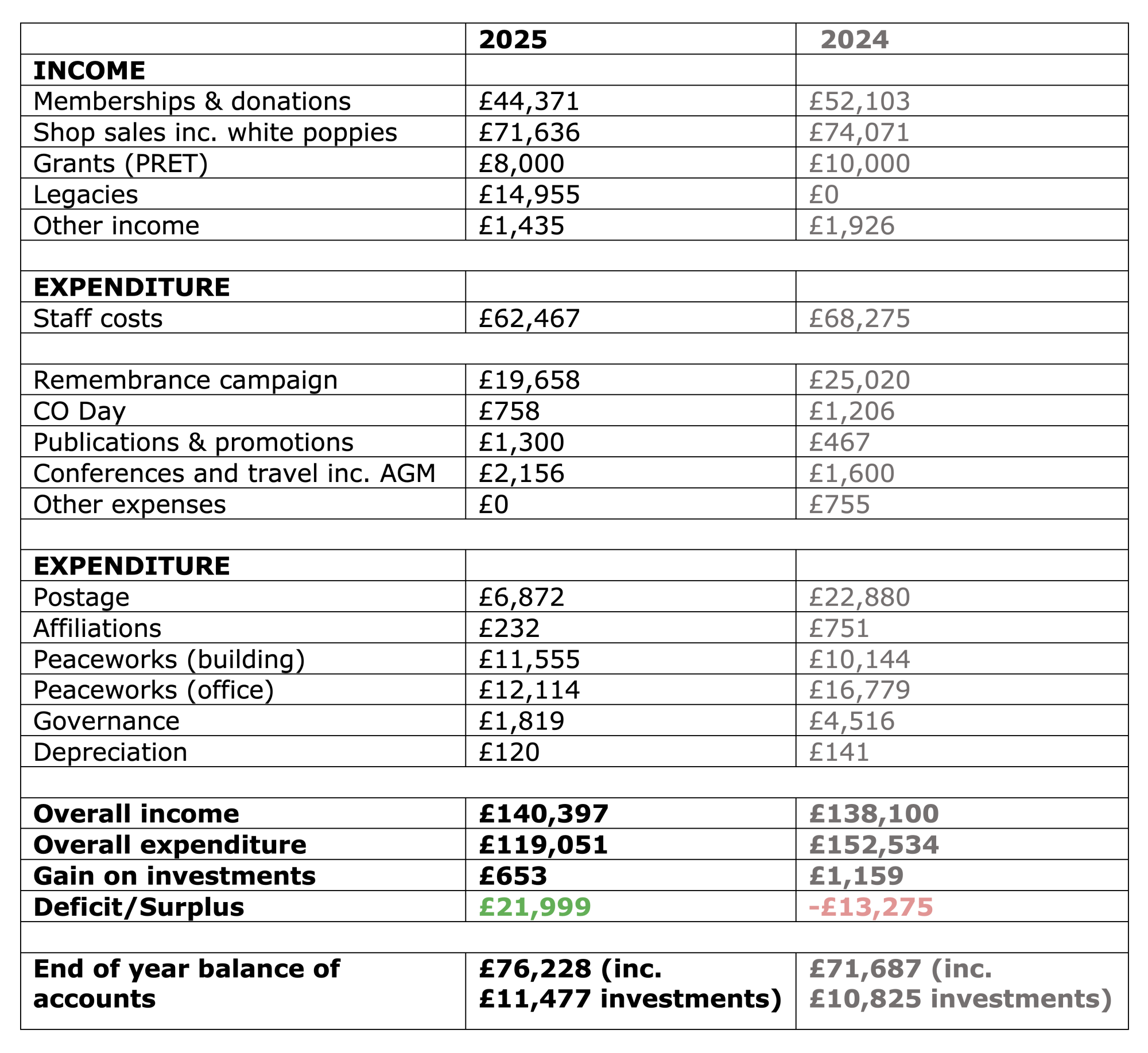
Financial Report