Annual Report 2024

Introduction
At the start of last year, the war in Gaza was in its first brutal months. Prime Minister Rishi Sunak was launching fresh attacks on Yemen, and the head of the British Army was raising the prospect of military conscription. This now seems like a long time ago. But a consistent theme since then has been the mounting devastation caused by wars around the world, coupled with growing militarism here in the UK.
It's not an easy time to be a pacifist, but we are lucky to have a growing and vibrant community of PPU members working for peace, as well as a strong network of extraordinary organisations and individuals who we work with. Our shared commitment to peace and nonviolence is so important in the face of an increasingly violent world.
Throughout 2024, PPU members and supporters have built campaigns for peace across the UK. Supported by our small staff team and generous volunteers in the PPU office, we have resisted arms fairs, challenged Armed Forces Day, introduced white poppies in schools, created a platform for conscientious objectors and other victims of war, added a pacifist voice to the movement for a ceasefire in Gaza, and much more.
Below is an update on the progress we made last year in each of our four campaigning areas: Everyday Militarism, Remembrance and White Poppies, Peacebuilding and Nonviolence and Military Spending and Recruitment.
Last year was the 90th anniversary of the PPU's founding in 1934, when Dick Sheppard issued an open letter asking people to sign the Peace Pledge and commit to opposing all war. We took the opportunity, in our 90th year, to reflect on what pacifism means now and how our resistance can be most effective.
The result was a new four-year strategy, which lays out our plans to grow our movement: promoting pacifism to a wider audience, opposing everyday militarism, expanding the reach of white poppies, whilst building our membership. It also sets out how we plan to ensure our financial stability, and we have taken important steps towards this over the last year. You can read the full strategy here.
We are still operating with a reduced staff team, though we are seeking funding to recruit a third staff member in the coming months. Our Operations Manager, Amy Corcoran, and Remembrance Project Manager, Geoff Tibbs, were joined for October and November by Minna Davies, our Remembrance Project Intern.
Everyday Militarism
Throughout 2024, we saw political rhetoric aimed at ramping up fear of military threats and support for extreme responses, from a 'citizen army' to 'war-footing' military spending plans.
Against this backdrop, everyday instances of military images, ideas and influence - what we call everyday militarism - become crucial for creating public consent. But where there is militarism, there will be resistance. We oppose everyday militarism wherever we find it - in communities, schools, universities and public debate.
The PPU has challenged Armed Forces Day since it was introduced in 2009. Not only do these events glorify and normalise the military, they are often marketed as 'family fun', with children routinely given real weapons to handle. In 2024, there was a noticeable increase in the numbers of people protesting Armed Forces Day around the UK, in some cases challenging the military presence, in others creating alternative events in parallel.
We worked closely with ForcesWatch to develop materials to support these protests. New postcards and stickers saying 'War is Not Family Entertainment' were distributed to groups and individuals in Aldershot, Cambridge, Irvine, Leeds, Leicester, Portsmouth, Weymouth and other places.
We successfully intervened in the media to publicise this opposition. Again working with ForcesWatch, we used information from numerous FOI requests to show that there has been a general decline in interest in Armed Forces Day, with a sharp drop in the overall number of associated events across the country since before the pandemic. Furthermore, there was no national event for Armed Forces Day, as no local councils came forward to host it. Our press release highlighting this was covered in The Telegraph and several other places.
Arms fairs are not only occasions to sell lethal weapons to authoritarian regimes, they are also a form of everyday militarism, with profound effects on local communities. In July, we protested against the Farnborough International Airshow, alongside local residents, Campaign Against Arms Trade, the Quakers and Greater Rushmoor Action for Peace. It was sickening to think that the planes roaring overhead, with their horrific carbon emissions and noise pollution, were the very same planes currently bombing Gaza. PPU members and others approached the arms dealers on their way in and out, offering flyers on the impact of the arms trade.
In August, we took up a more unusual issue close to the PPU's heart. Benjamin Britten's War Requiem was due to be performed at the BBC Proms. Britten was a pacifist, conscientious objector and prominent PPU member for decades. We booked an advert in the concert programme, pointing out that the War Requiem was itself an artistic expression of the horrors of war and Britten's pacifist beliefs.
Although the advert was not polemical, the BBC overruled it, pulling it from the programme before it went to press. In response, PPU members protested outside the Proms concert, handing out copies of the banned advert. Ironically, by stopping the advert, the BBC attracted far more media attention than it would have otherwise - see for example this coverage of our press release in The Independent.
Remembrance and White Poppies
The white poppy often gets accused of politicising remembrance. Our response is that remembrance is always political. The way we remember the past informs how we act in the present.
Official events to mark the 80th anniversary of D-Day last year included military flyovers and 1940s-style entertainment, and spoke about 'celebration' and 'heroism', with little reference to the widespread suffering caused by the fighting. These events, and others to commemorate the end of the Second World War this year, are an important backdrop to the UK government's increasingly militaristic policies.
The white poppy provides an alternative, reminding us that war should never be celebrated, its victims never forgotten and its mistakes never repeated.
Last year, we noticed white poppy wreaths featuring in a larger number of official remembrance events, suggesting steadily growing acceptance of white poppies across the UK. PPU members have successfully worked with local councils, the Royal British Legion and others to incorporate white poppies into official ceremonies. In some places, such as Leicester, Aberystwyth and Stowmarket, white poppies have become a longstanding part of official commemorations, while in others they have only recently been introduced.
Likewise, more and more schools, universities and other educational settings have been adopting white poppies - record numbers last year. Teachers cited the war in Gaza as one reason for this trend, as more of their students recognised the importance of remembering all victims of war, including civilians and those affected by wars happening now.
In the run up to Remembrance Day, a team of twenty or so PPU volunteers came to a series of demonstrations calling for a ceasefire in Gaza. We handed out thousands of white poppies. Their message of remembrance for all victims of war - including civilians, who have been so badly affected by the war in Gaza - resonated widely, and by the end white poppies were a common sight among the crowds.
As always, all these initiatives are largely down to the dedication of PPU members and supporters advocating for the white poppy around the UK, whether by bringing them into shops, schools and community spaces, distributing them on the street, or packing white poppies to distribute in the PPU office. All in all 77,000 white poppies were distributed in 2024.
On Remembrance Sunday, we launched a new project, Decolonising Remembrance. This work has arisen out of discussions over the last few years, acknowledging that the history of British warfare is deeply intertwined with the history of Empire - a fact routinely ignored in mainstream remembrance occasions. The project aims to ensure that the victims of colonial wars are remembered, alongside others, on Remembrance Day. It also challenges the legacies of colonialism, which continue to influence who is publicly remembered and whose histories and experiences are erased. You can read more about the project here.
The launch of Decolonising Remembrance got a good amount of coverage, notably in The Telegraph and LBC, prompting a sharp backlash on social media. Whilst this points to the difficulty of this work, it also highlights its importance, given that mentioning those affected by the wars of the British Empire clearly touches such a nerve.
Numerous alternative remembrance ceremonies took place around the UK to mark Remembrance Sunday. In London, the National Alternative Remembrance Ceremony featured two Palestinian speakers: Nadine Aranki, who spoke about her family in Gaza, and Marwan Darweish, who shared his parents' experience of the Nakba. Jon Nott from CAAT and Roger McKenzie from CND and the Morning Star spoke powerfully about their campaigning against militarism and causes of war. The event was tied together brilliantly by our host Kate Smurthwaite. You can watch the speeches on our YouTube channel.
We continue to work closely with Cymdeithas y Cymod to distribute Welsh white poppies. Last year we introduced bilingual Welsh and English materials, including a new bilingual display box of white poppies.
Peacebuilding and Nonviolence
The Peacebuilding and Nonviolence strand of the PPU's work is concerned with promoting nonviolent alternatives to war and violence. We provide a range of educational resources for primary and secondary levels as well as for higher education. These resources help children and adults to explore approaches to conflict, ethics around war and peace, and the history of conscientious objection and nonviolent resistance.
We have one of Britain's most extensive archives on conscientious objection and peace history, and maintain this for use by students and researchers. We maintain a detailed and lively website called The Men Who Said No, telling the stories of conscientious objectors in the First World War.
In the next few months we are planning to recruit a new member of staff and, in a change from previous practice, the educational brief will be shared across the staff team. This will allow a greater degree of consistency in our educational work. In the meantime, PPU members and staff are ensuring that this work continues.
We continue to be an active member of the Peace Education Network (PEN), contributing to discussions with other organisations at its regular meetings. Along with other PEN members we contributed to Teach Peace Secondary, which was launched in February and offers over 50 cross-curricular lessons on topics including challenging racism, conflict transformation and the arms trade.
Members of the PPU have been staffing a stall at the National Union of Teachers (NUT) and now the National Education Union (NEU) Conferences since 2017, building up a significant number of contacts for its informal network of teachers. In April 2024, we backed teachers who were challenging a rise in military spending against the backdrop of a desperately underfunded education system. We ran a stand at the conference of the NEU in Bournemouth, building our peace education network and raising awareness about the increasing involvement of the military in our schools, the expansion of cadet corps as well as alerting delegates to the next DSEI arms fair scheduled to take place in London in September 2025. We shared our stand with PEN, enabling the successful distribution of hundreds of copies of Teach Peace Secondary.
The PPU values its link with the Institute of Education and continues to attend meetings as part of the UCL Peace Education Special Interest group.
We continue to work closely with Woodcraft Folk to support peace education among their groups of young people across the UK. The white poppy activity pack, jointly developed by Woodcraft Folk and the PPU, remains freely available to Woodcraft Folk groups in the run up to Remembrance Day. In January, a member of PPU Council facilitated a session on pacifism for a Woodcraft Folk group in North London.
Our work in Wales continued to flourish in 2024, with a strong focus on engaging with Members of the Senedd ahead of next summer's Welsh elections. We wrote to the incoming First Minister to call for Wales to build a culture of peace, based on its proud traditions, and to take a clear stance on current global conflicts. We also worked with the coordinating group Heddwch ar Waith as part of a bigger peace event involving organisations from across Wales, at the Senedd in March. This saw the PPU work with Quakers Wales on a session about military visits to Welsh schools, and the role of peace education in countering these. Separately, members in Wales continue to communicate and meet informally online to identify new opportunities for PPU action.
Military Spending and Recruitment
At the very start of 2024, the UK joined the US in attacking Houthi targets in Yemen. This was a reckless move, set against the backdrop of Israel's attack on Gaza - backed militarily and diplomatically by the UK - and threatened to further escalate the regional war in the Middle East. We called out the UK government's imperial arrogance and irresponsible approach to international security.
Escalating conflict abroad was mirrored by growing militarism at home, with the Tory government using increasingly alarmist military rhetoric. In this context, our campaign on military spending and recruitment has been especially urgent. We aim to put forward the arguments against the UK's spiralling military budget and damaging military recruitment practices, offering up to date resources on our website on these issues.
For the first time in several generations, the spectre of military conscription has been raised in the UK. General Sir Patrick Sanders' call for a 'citizen army' reflected the increasingly aggressive militarism of the UK political establishment. In our statement in response to Sanders' speech, we said: “Military conscription is a violation of our basic freedoms and human rights, and must be resisted at every turn... Now that the prospect of military conscription has again been raised in the UK, we urge people to become conscientious objectors to the very idea of conscription.”
The PPU is one of the few UK peace organisations with an active memory of conscription, as it grew out of the conscientious objectors' movement during the First World War. We supported COs during the Second World War and continue to do so today - as we did on International Conscientious Objectors' Day (CO Day) on 15th May.
On CO Day, we gave a platform to the Israeli conscientious objector, Or, who has served multiple prison sentences for her refusal to join the Israeli military. She issued a public call for solidarity with conscientious objectors facing persecution worldwide, before speaking at the London ceremony for CO Day in Tavistock Square.
CO Day is a moment in the calendar when we work closely with War Resisters' International - of which the PPU is the British section - as well as a coalition of thirteen peace organisations. Together, we maintain a wealth of resources on the history and contemporary struggles of COs around the world.
This work could not have been more timely in the UK, as later in May the Tory government announced plans to reintroduce national service, in the first major announcement of their reelection campaign. We immediately pledged to resist the scheme, if it is ever implemented, warning that it would be met by waves of resistance from young people.
Meanwhile, UK military spending continued to skyrocket during 2024, with Rishi Sunak announcing a further £75bn over six years during a visit to Poland, as well as additional military support for Ukraine. We accused the government of inflaming global tensions, as the increase sent a clear hostile message to Russia, China and other countries, as well as wasting public funds during a cost-of-living crisis.
Sadly this trend looks set to continue under the new government, making it all the more important that we continue to raise awareness of the grave dangers of military spending, as well as alternative approaches to security based on diplomacy and cooperation.
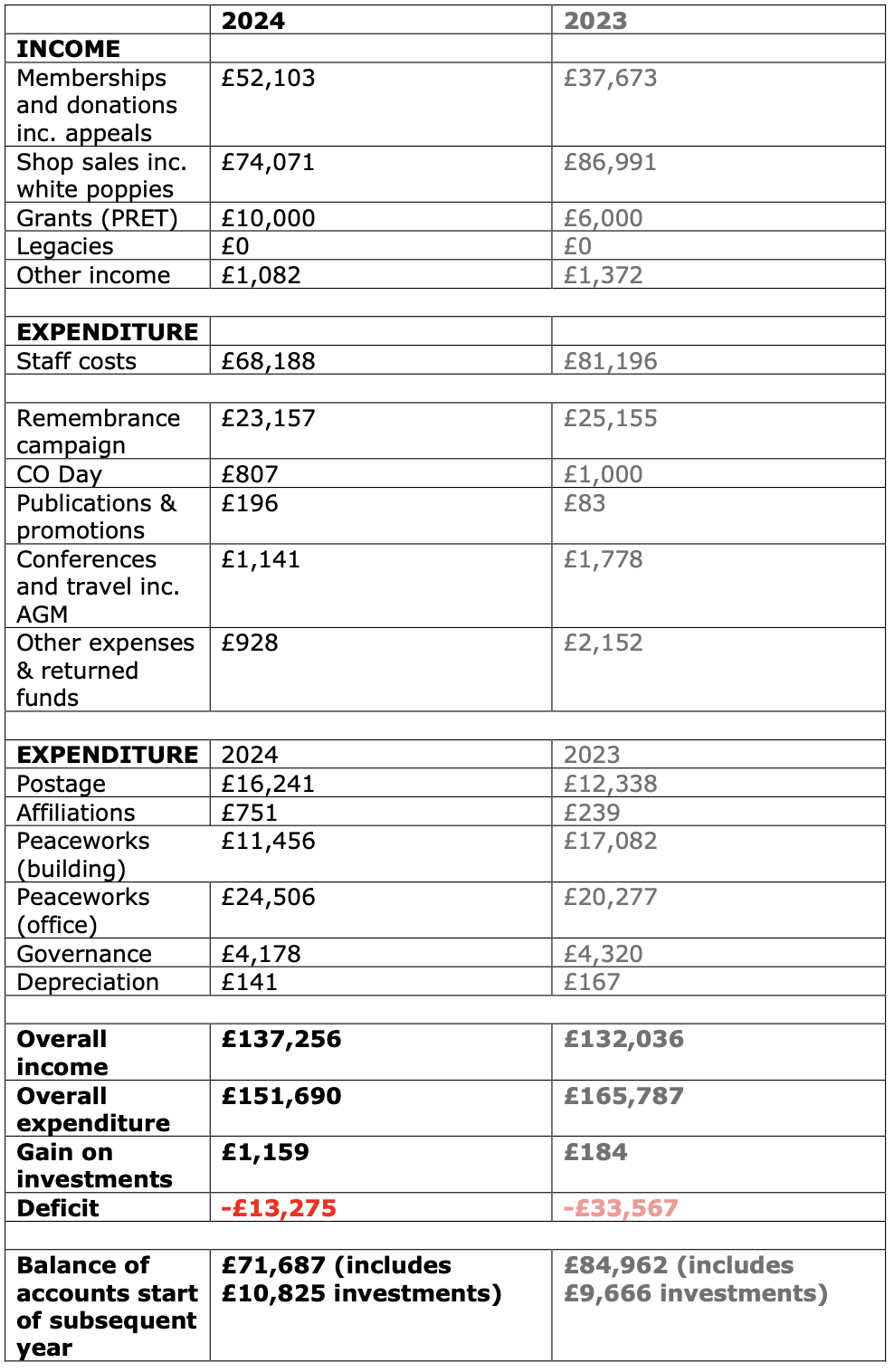
Financial Report